



 Menu
Menu


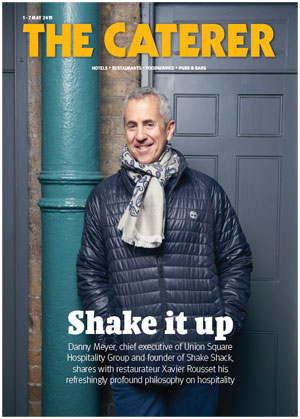
Danny Meyer: seven secrets of his success
What:
Read the full Rousset Interview in this weekâs The Caterer magazine, out 1 May 2015. Get your copy here!
1. Good food is not enough
âNo oneâs going to come back to your restaurant just because you have good food, and they definitely wonât come back if you donât,â Meyer explains. âLetâs say there are 50 other places whose food is just as good yours â" thatâs where hospitality comes in.â
2. Design doesnât make or break a restaurant
âThere are many restaurants where whatâs on the plate and whatâs in the glass and how good the welcome is matter much more. That doesnât mean that good design canât improve a restaurant, but weâve all had wine where the label was better than the liquid in the bottle, and so it can be with restaurant design.
âI would start off with making the experience great, even with a modestly designed restaurant, and once you have a following you can always make the decor nicer.
âThat doesnât mean you shouldnât care about the design â" we put a lot of thought into the design of Shake Shack â" and I think thereâs a correlation between higher-revenue restaurants and those that care about design. However, itâs still not as important as the product and the quality of the hospitality.â
3. The process of keeping happy staff is like being a winemaker
âThere are four processes involved, three of which you can control,â says Meyer. âYou can control the rootstock and where you plant it â" the terroir. So, did you hire the right people? Because the wineâs never going to taste any better than the worst rootstock, and weâre never going to do any better than the worst person we hired.
âThe culture is incredibly important. Letâs say we hire the right person, but the culture, the way we do things in the restaurant, is toxic â" that employeeâs not going to thrive.
âThe third thing is training the vines. So get the right rootstock, keep the soil healthy and train it.
âLastly, we cannot control the vintage or the climate, but a good winemaker makes the best wine, even in a bad year, and a good restaurateur has the capability of having the best staff, even when the economyâs not great.â
4. Team first, customers second
âUnfortunately, in many societies, the restaurant guest is the master and the person in front of house is the servant.
âTherefore, when we hire people, we really make it clear that hospitality is our game. The first stakeholder that receives our hospitality is our own team, and that means you will be responsible for us, for how well you take care of each other.
âIf we can start a virtuous cycle by uplifting human energy among people who work there, we believe that becomes infectious and then everyone wants to take good care of our guests.
âI canât do that overnight, but I can tell you, having been in the restaurant business for over 30 years, that putting your own team first and putting customers second enables you to attract people who are able to break out of that master/servant relationship, because if their own boss is empowering them to use their hearts and minds to do great things for each other and for the customers and the community, itâs a more highly respected pursuit.â
5. Location is not crucial to a restaurantâs success
âI believe context is more important than location. Restaurants can open in locations that stores couldnât. But in the context of a neighbourhood in the making, a restaurant can help a location as much as a location can help a restaurant.â
6. Know your business to get the benefits of reviews
âThe problem with so many reviews, whether theyâre from amateurs, bloggers or professional media, is that youâre picking up so much information that itâs very, very easy to pick up static.
âThe key thing for a restaurateur is to know your business well â" itâs important to listen and look for patterns. So, in other words, if I read 50 things, whether they were by an amateur or a professional, if one of them says âI love everything about the restaurant except the uniformsâ, thatâs OK.
âIf four of them say it, listen carefully.â
7. Pretend the food is free
âIf you come to my restaurant, at its core is the base transaction of âyou give me money and I give you foodâ.
âHowever, we try to teach our staff that if somebody comes in and orders a cheeseburger or a milkshake or a Cumberland sausage or an ale, pretend the food is free, and pretend that what theyâre really paying you for is the hospitality. How did you make each other feel, and how did you make them feel?
âThatâs whatâs going to make people come back.â
Read the full Rousset Interview in this weekâs The Caterer magazine, out 1 May 2015. Get your copy here!
Â







Most Popular


Webinar: AI for Guest Experience
 Wed Jan 28, 2026
Best Places to Work in Hospitality 2026
Wed Feb 4, 2026
The Caterer Supplier Awards
Thu Apr 16, 2026


The Caterer provides trusted hospitality news, analysis and trends for restaurants, hotels and catering professionals.

Jacobs Media is a company registered in England and Wales, company number 08713328. 3rd Floor, 52 Grosvenor Gardens, London SW1W 0AU.
© 2025 Jacobs Media
