



 Menu
Menu


Bánh mì chả cá: Vietnamese baguette with fish cake recipe
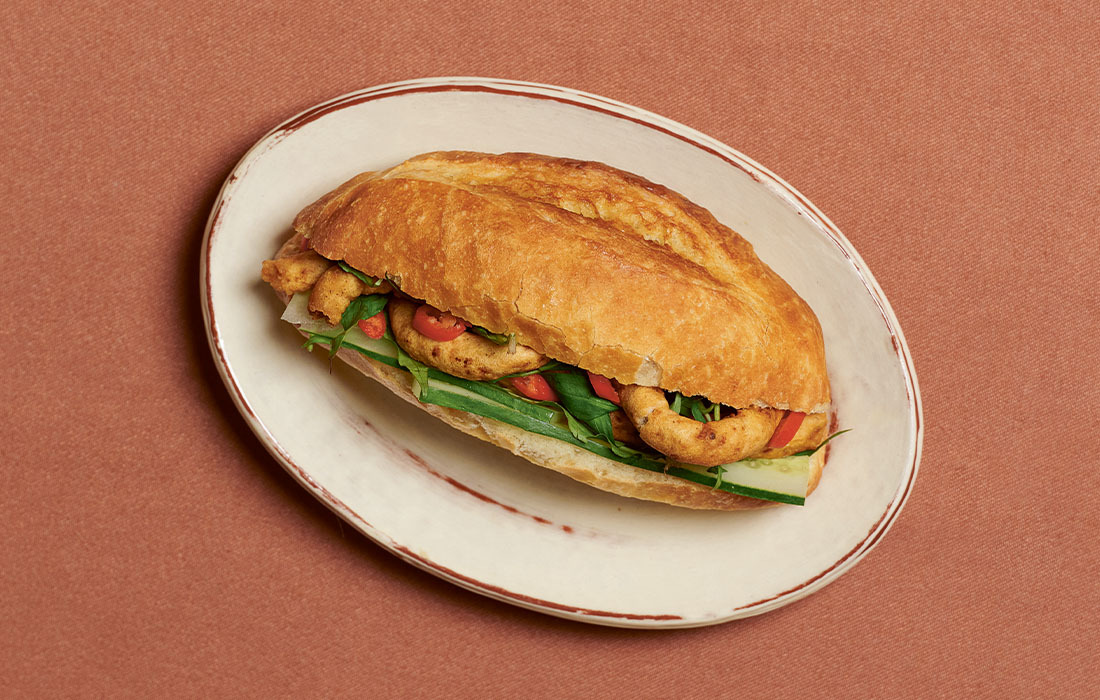
Recipe for bánh mì with tuna fish cake – from Vietnam: The Cookbook by Anaïs Ca Dao Van Menen
This recipe uses mackerel for its elasticity, while the more traditional version, fried strabismus fish cake, uses freshwater fish and is often served with noodles. Traditionally these fish cakes were shaped into round patties and then thinly sliced. A new style has emerged, where the batter is pressed into long ‘noodles’ directly into hot oil for crispier edges. I like to add pickled daikon and carrots to this bánh mì.
Makes 1 baguette
Preparation time: Approx. 30 minutes
Cooking time: 7–8 minutes
- 1 Vietnamese baguette (recipe below)
- Soy sauce (I use Maggi), for drizzling
- Hot sauce, for drizzling
- 40-50g tuna fish cake piped before cooking (recipe below)
- 4-5 chilli slices
- 25g cucumber, sliced
- 10g Vietnamese coriander
Using a sharp knife to split the baguette lengthways.
Layer the ingredients in the following order: sauce of your choice, hot sauce, fish cake pieces, chilli slices, cucumber and, Vietnamese coriander.
Note: To make piped fish cakes, heat the oil, then put the fishcake mixture into a piping (pastry) bag and pipe directly into the hot oil. Alternatively, you can make the fish cake into patties as in the tuna fish cake recipe and then cut it into pieces to serve.
Chả Cá Thu: Tuna fish cake recipe
Made with salt water tuna, seasoned with lemongrass and Vietnamese coriander/cilantro, this fish cake differs from the sweet water fish cake varieties.
Makes approx: 900–950 g
Preparation time: 20 minutes
Cooking time: 10 minutes per batch
For the fish paste
- 440g tuna fillet, deboned
- 2tbs neutral oil
- 1tbs pork fat
- 15g peeled garlic
- 15g spring onions, sliced
- 10g peeled shallot
- 1 bird’s eye chilli
- 5g long red chilli
- 2tbs cornflour
- 1⁄2tsp sugar
- 1tsp all-purpose seasoning (hạt nêm)
- 1tsp fish sauce
- 1⁄4tsp black pepper
- 3tbs ice water
- 22g Vietnamese coriander (rau răm), finely chopped salt, to taste
For frying
- Oil, for deep-frying 2 lemongrass stalks
To make the fish paste, in a blender, combine all the ingredients, except the Vietnamese coriander/cilantro, and blend until it forms a smooth paste. Fold in the Vietnamese coriander.
In a large pan, pour enough oil to half-fill. Add the lemongrass stalks and heat the oil over a medium heat.
Shape the fish paste into small patties or balls. Carefully place the fish cakes into the hot, lemongrass-infused oil. Fry on both sides until golden brown and cooked through, 3–5 minutes per side. Remove the fish cakes from the oil and drain on paper towels.
Serve hot as a starter (appetizer) or main dish with a dipping sauce.
Bánh Mì: Vietnamese baguette recipe
As food historian Erica J. Peters documents in Appetites and Aspirations in Vietnam, bread making in colonial Vietnam began in the 1860s when the French military trained local workers to bake for their troops. What started as military provisions eventually spread through cities as Vietnamese and Chinese bakers opened their own boulangeries, making bread increasingly accessible to the local population. Over generations, bakers adapted the craft to local conditions. Nowadays, this has become a staple in the Vietnamese breakfast diet, and can also come in different shapes from rounded bánh mì cóc or long and thin bánh mì que.
Making these baguettes in Vietnam’s tropical climate requires specific adjustments to flour types and attention to humidity levels. Nowadays, it is not uncommon to use bread improver to keep the bread consistent. If used, add 2.5 g to the recipe.
Makes 8
Preparation time: 15 minutes, plus 45 minutes proving and 81⁄2 hours chilling times
Cooking time: 16 minutes
- 500g 13% protein flour
- 5g (approx. 1.5tsp) fast-action dried yeast
- 315g refrigerator-cold water
- 10g butter, plus 2tsp for scoring
- 2 × 250mg vials ascorbic acid
- 1⁄4tsp salt
- Oil, for greasing
In a stand mixer fitted with the dough hook, combine all the ingredients except the salt. Mix for 1-2 minutes on medium speed. Add the salt and knead for one more minute. Increase to high speed and mix for 2-3 minutes until the dough reaches 25°C.
Lightly oil a large bowl. Remove the dough from the mixer and transfer to the bowl. Cover with clingfilm and let rest for 30–40 minutes at room temperature (cooler climates will need the longer proofing time).
Divide the dough into eight pieces (100 g each). Lightly oil the top of each piece. Cover with clingfilm and rest for five minutes.
To shape into baguettes, flatten each piece, roll tightly and taper the ends, then place on a baking sheet. Cover the shaped rolls and refrigerate for eight hours or overnight.
Remove the dough from the refrigerator 15 minutes before baking, leaving it uncovered. Using a bread knife or sharp blade, make a curved slash on the top of each baguette, then add a small piece of butter in the scored line.
Preheat the oven to 240°C with a tray on the bottom. Fill a spray bottle with water and set aside.
Place the bread in the oven, fill the tray on the bottom with 60–100 mlof water and then spray the bread with the water from the spray bottle 10 times. Reduce the heat to 170°C and bake for nine minutes. Remove the tray, increase the heat to 190°C, and then bake for five more minutes or until golden brown. Flip the rolls over and bake for two more minutes on the other side. Alternatively, bake for 9 minutes, reduce the heat to 170°C and bake for seven more minutes.
Remove from the oven and eat hot, fresh out of the oven or let cool for a sandwich. The baguettes will keep for up to 5 days.
Vietnam: The Cookbook by Anaïs Ca Dao Van Menen, Phaison Press, £39.95


Most Popular


Best Places to Work in Hospitality 2026
 Wed Feb 4, 2026
Webinar: AI - building trust in the workplace
Wed Feb 18, 2026
The Caterer Supplier Awards
Thu Apr 16, 2026
The Acorn Awards 2026
Sun Jun 7, 2026


The Caterer provides trusted hospitality news, analysis and trends for restaurants, hotels and catering professionals.

Jacobs Media is a company registered in England and Wales, company number 08713328. 3rd Floor, 52 Grosvenor Gardens, London SW1W 0AU.
© 2026 Jacobs Media
