



 Menu
Menu


AI: Five crucial questions for hospitality businesses

When thinking about whether to adopt artificial intelligence in your business, you need to gauge where it will fall within your employee, cost and skills capacity. The Caterer’s AI Summit asked the experts to explain
Artificial intelligence is fast becoming a highly integrated aspect of everyday life in hospitality, but operators still have concerns about its use, in anything from data management to its complexity.
To discuss how best to approach adding AI to your operation, The Caterer hosted an AI Summit in partnership with self-checkout manufacturer and catering supplier Autocanteen.
The audience heard from Gianmarco Fiorilla, tech innovation strategy manager at Accenture, followed by Sergii Khomenko, founder of Autocanteen, and researcher Dr Nicola Millard, principal innovations partner at BT.
The session featured a panel discussion with Raj Jeyaratnam, special projects director at CH&Co, Mike Rawson, chief information officer at Citizen M, and Julie White, chief commercial officer at Accor, sharing insights into how their respective businesses have adopted AI.
They discussed the integration of AI in hospitality, highlighting its impact on cost savings, client and customer service, as well as operational efficiencies and potential risks.

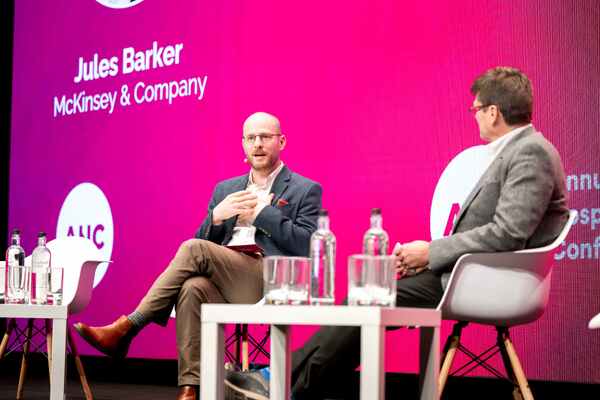
Speakers, top row from left: Gianmarco Fiorilla, tech innovation strategy manager, Europe & Middle East, Accenture; Raj Jeyaratnam, special projects director, CH&CO; Sergii Khomenko, founder, Autocanteen. Bottom row: Nicola Millard, principal innovation partner, BT; Mike Rawson, chief information officer, citizenM; and Julie White, chief commercial officer, Europe and North Africa, Accor
1. Will AI make my life easier?
Millard said that humans tend to look for the easiest route when tackling a project, and if AI can help us achieve that, its implementation should be a success.
She said the best way to sell AI in the workplace is to prove that it’ll add purpose, autonomy and mastery to roles. If AI can take away some of the repetitive elements of a job, it can lead to staff developing skills that would be more beneficial to a company, such as giving them the opportunity to use their skills more creatively.
Similarly, Rawson stressed that the reason behind implementing AI should be to “either add value or reduce friction” – if you can prove its feasibility through a pilot study, it should be rolled out.
2. Will AI be a companion or a replacement?
Fiorilla said he wanted businesses to “start shifting away from worrying about working with AI”. He said that AI is not going to replace humans, rather, its implementation into daily working life will enhance it.
He said AI can be a natural companion to daily tasks and cited businesses’ use of large language models (LLMs), which can produce human-like text to personalise communications, from marketing emails to chatbots. He said that training the model with the company’s tone of voice and style of writing can be straightforward.
All panellists highlighted AI’s use in automating back-of-house tasks, meaning staff can be reallocated elsewhere in the business.
Rawson shared the example of Robbie, Citizen M’s first digital employee, which oversees much of the company’s financials. Rawson said that Robbie’s implementation resulted in it doing “50% to 70% of invoice processing, [resulting in the loss of] a couple of those transactionally based roles”, yet many other roles were repurposed or people were promoted or retrained.

Autocanteen
Khomenko explained how Autocanteen used AI to redistribute staff and improve customer interaction. He took a client case study of an office in Canary Wharf in London where there are four self-service checkouts. After its installation, the checkouts saved 360 days of labour and 400 hours of queuing a year. He said the process handles up to 20 transactions per minute at peak periods, as opposed to two transactions per minute with a person-managed till. This, he said, frees up staff to assist with customer service, “rather than just keying things into a till”.
3. Can I train my employees to use it?
The onus is on the business to upskill employees to leverage AI effectively and efficiently, said Rawson.
He added “there’s no question” that businesses will be looking to use AI to improve efficiencies in highly transactional and repetitive roles, but then “the question becomes, are you going to upskill [your people]?”.
Rawson said that companies with a strong people development culture should endorse the use of AI so they can deploy their people where they are needed: “Embrace it and learn as much about it as possible so you can upskill,” he concluded.
Jeyaratnam agreed and added that businesses need to train staff and not just throw new technology at those who are unaware of how to use it. Rather, it should be promoted “off the bat”, so employees can make best use of its capabilities to enhance their current role.
In addition, upskilling staff will also enable them to look out for the risks and vulnerabilities that working with AI can pose, as White noted. She added that continuous education of AI’s opportunities as well as its risks is one of the best ways staff can ensure data belonging to customers, clients and employees is kept safe.
4. Can I afford it?
AI has as much of a home in a high-end restaurant or multinational as it does in a small-scale establishment or independent hotel, but, while the first two have the financial resources to implement a sophisticated AI system, for the latter, the cost can seem prohibitive.
However, this needn’t be so, said Jeyaratnam. There are many off-the-shelf solutions a small business can incorporate into its operations, many of which “often have monthly commitments, therefore you can do it quickly for, hopefully, not too much money”.
And even if there is an initial high outlay, the financial return can be quick, as evidenced with services such as Autocanteen, where its implementation can pay back quickly due to the efficiency of its service: “Transactions only take 10 seconds on average, which means faster queue processing and more revenue for hospitality businesses,” said Khomenko.
5. Should I do this alone?
All panellists agreed that when implementing AI, it is best to collaborate with external providers whose expertise will make it easier to implement the software quickly and efficiently.
Not only that, but, as White pointed out, outsourcing its AI requirements has been a great way of scaling-up Accor’s AI usage. She cited the company’s use of AI in revenue management. Accor partnered with hospitality management firm Ideas, which used a tool to track the history of booking patterns, inventory and historical data over several years, combined it with customer demand, and then produced recommended pricing levels for revenue managers to make room cost decisions.
Similarly, Robbie was built externally by IT automation and implementation company Freeday.ai in the Netherlands. Rawson said working with them was “super useful” because of their expertise in IT and financial automation.
In addition, as Jeyaratnam pointed out, an external provider should have the right qualities and procedures in place to keep data safe and store it in the right way – but, he added, “do your due diligence”.
AI is making waves across every corner of the industry. Whether it’s a small catering firm to a multinational hotel chain, its implementation can have a multitude of benefits, including improving operational efficiency and enhancing client and customer interaction.
And while it still can be a cause for concern, with worries ranging from data protection to job security, as hospitality companies embrace it more and more, and employees use it alongside their day-to-day role, the benefits will become evident.
Watch the recording of the AI Summit
From the sponsor

Autocanteen was proud to participate in and sponsor the AI Summit organised by The Caterer, which included hospitality and technology industry experts sharing their views on the impact of automation in the sector.
Autocanteen has pioneered with AI self-checkout for catering in the UK since 2020 and has closely worked with partners to deliver truly impactful and service enhancing solution to the sector. Autocanteen terminals enhance speed of service and allow operations teams to focus on customer service by automating the checkout journey in workplaces, warehouses, factories and adventure parks in the UK, EU, Canada and US.
Find out more at The Caterer Summits

The Caterer Summits are a series of webinars and events on specialist subjects in hospitality, with guest speakers and experts sharing their views on subjects ranging from finance to recruitment, both in person and via webinars.
Register for the free online Maximising Revenue Summit, on 29 April now









More from The Caterer
Most Popular




The Acorn Awards 2026
 Sun Jun 7, 2026
The Cateys 2026
Tue Jul 7, 2026
Natural & Organic Food Show
Wed Sep 16, 2026 ExCel London
Artisan Food & Drink Show
Wed Sep 16, 2026ExCel London


The Caterer provides trusted hospitality news, analysis and trends for restaurants, hotels and catering professionals.

Jacobs Media is a company registered in England and Wales, company number 08713328. 3rd Floor, 52 Grosvenor Gardens, London SW1W 0AU.
© 2026 Jacobs Media
