



 Menu
Menu


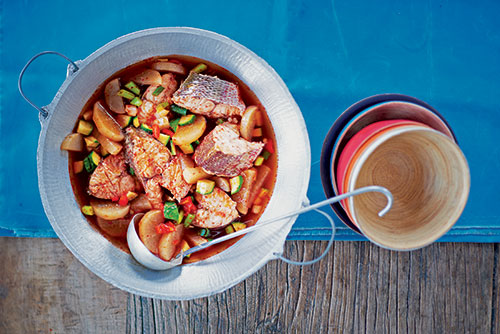
Recipe: Mae-Un-Tang (fish market fish stew)
This dish tastes like Korea to me, its deep-sea flavours conjuring up memories of time spent there in restaurants by the beach. If you order sushi (or hwe in Korean) in Korea, this dish is usually served at the end of the meal. The ajummas take all the remaining sushi from your table and boil it up along with the chilli paste and any heads and bones from the fish. It's a fantastic way of making sure that nothing is wasted, though it does mean that you're often left with a soup that is full of bones and not a lot of fish! In this version there's plenty of fish to go around.
Serves 6-8
-
- 600g mooli, halved lengthways and cut into 5cm (¼in) slices
- 1-2 whole red snapper(s), about 750g in total, descaled, cleaned and cut into 5cm-thick steaks (ask your fishmonger to do this for you)
- 3 spring onions, trimmed and roughly chopped
- 1 long red chilli, trimmed and roughly chopped
- 1 courgette, roughly chopped
For the paste
- ½ tbs gochujang (Korean red chilli paste)
- ½ tbs doenjang (Korean soybean paste)
- 3tbs gochugaru (Korean red chilli powder)
- 6 garlic cloves, minced
- 3tbs light soy sauce
- 1½tbs fish sauce
- Pinch of pepper
For the paste, mix together all the ingredients in a bowl. Set aside.
Pour the stock into a large heavy-based saucepan or stockpot and bring to a boil. Add the mooli, reduce to a simmer and cook over a gentle heat for 7-8 minutes, until the mooli begins to soften.
Stir the paste through the broth, add the fish, spring onions, chilli and courgette, and simmer for a further 6-7 minutes, until the courgette has softened and the fish is cooked through. Transfer the still-bubbling pan to a heatproof stand in the middle of the table for everyone to help themselves.
Myeulchi gookmul (anchovy stock)
Knowing how to prepare your own anchovy stock is a basic essential when it comes to Korean cooking, and itâs so easy to make. It doesnât taste overly fishy as the anchovies are just dried and not salted, but it gives a really clean, deep savoury flavour to the many soups and stews in which itâs used.
Makes about 1.5 litres
- 375g mooli, cut into 5cm pieces
- 1 onion, roughly chopped
- 2 spring onions, trimmed and roughly chopped
- 4 whole garlic cloves
- 2 litres (3½ pints) water
- 15 large dried anchovies, halved and gutted
- 5 x 5cm (2inch) dashima (kombu) kelp squares
Put the mooli, onion, spring onions, garlic cloves and 1 litre of the water in a large saucepan or stockpot. Bring to the boil, then reduce the heat and continue to simmer for 20 minutes.
Add the anchovies to the pot along with the kelp squares and the remaining water, return to the boil and cook for a further 20 minutes, skimming off and discarding any foam from the top of the stock with a slotted spoon as you go, until the liquid is a light brown. Remove from the heat and leave to cool.
Once cool, strain the stock through a colander to remove the vegetables. Use straightaway or pour into a suitable container and refrigerate for up to two days, or freeze for longer.
Recipe taken from K-Food: Korean Home Cooking and Street Food (reviewed here). Photography by David Munns
Are you looking for a new role? See all the current restaurant vacancies available with The CatererFONT >>
Latest video from The Caterer





Most Popular


The Caterer People Summit 2026
 Thu May 14, 2026
 The Line, London
The Acorn Awards 2026
Sun Jun 7, 2026
The Cateys 2026
Tue Jul 7, 2026
Natural & Organic Food Show
Wed Sep 16, 2026ExCel London


The Caterer provides trusted hospitality news, analysis and trends for restaurants, hotels and catering professionals.

Jacobs Media is a company registered in England and Wales, company number 08713328. 3rd Floor, 52 Grosvenor Gardens, London SW1W 0AU.
© 2026 Jacobs Media
