


 Menu
Menu


‘If we want to maintain trust in our brands, net-zero is imperative’: Why business leaders need to get up to speed on sustainability

Enthusiasm and investment for going green is lagging, yet it’s essential both to attract guests and for the planet. The Caterer’s Business Leaders Survey looks at how to keep up with the competition
Making your business more sustainable can bring a myriad of benefits, from providing resilience and security to engaging partners and guests. However, in the face of mounting cost pressures and operational challenges, there’s evidence that operators are shying away from significantly improving their green credentials.
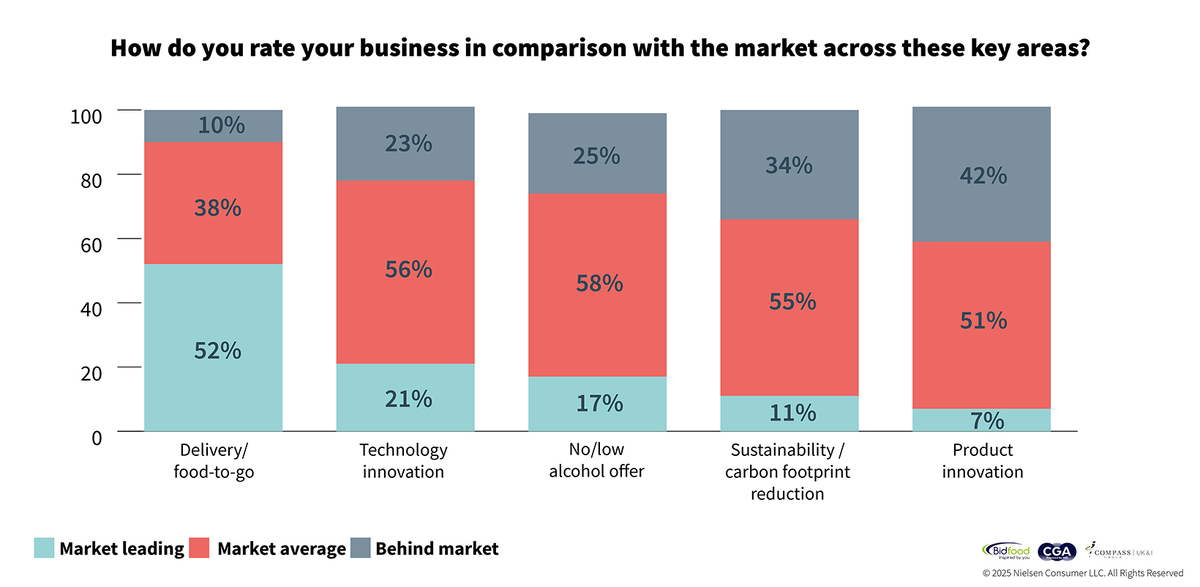
Just 11% of respondents to the Hospitality Business Leaders Survey 2025, produced by The Caterer and CGA by NIQ and sponsored by Bidfood and Compass Group, feel their operation is market-leading in terms of sustainability. A further 55% feel they are in-line with the market, while a significant 34% feel they are lagging behind industry peers.
Sue Williams, founder of Positive Hospitality, which provides support to those in the hospitality sector looking to embed sustainable practices in their business, says despite the challenges being faced, operators can’t afford to delay their efforts to reduce their negative environmental impact and prepare for operating in an era of climate change.
Williams was instrumental in driving the sustainability journey for Whately Manor in Malmesbury, Wiltshire, where she was general manager until 2023. She helped the hotel reduce carbon emissions by 48%, compared to its base line of 2019. The remaining emissions are currently offset through the purchase of carbon credits, while the hotel continues to work to reduce its impact further.
She says: “The goal has to be net-zero or, as the climate crisis deepens, net-positive should be the ambition. Currently, operators are not setting robust enough targets to protect their businesses. A lot of good work is being done, which is great to see, but most of the initiatives are about operational resilience and not part of a strategic net-zero roadmap. If we want to maintain trust in our brands and protect our assets, net-zero is imperative.
“Getting to grips with data and measurement is a necessity to be able to understand your complete carbon footprint. This includes scopes 1 and 2 for your burnt and bought energy and scope 3 for your full supply chain emissions, which will account for approximately 80% of your greenhouse gas emissions.”
From the ground up
Casual dining group Wahaca was the first UK restaurant group to gain a CarbonNeutral company certification and aims to achieve net-zero by 2030. It was also named the UK’s most sustainable restaurant group by consumer group Which? last year.
Wahaca’s sustainability manager Carolyn Lum says that a desire to be as sustainable as possible needs to be embedded within company values if a business wants to be market-leading, and this is something the Wahaca’s founders, Mark Selby and Thomasina Miers, have championed since opening their first restaurant in 2007.
Lum says: “We try to have a holistic view of sustainability. We focus on emissions and aim to reduce our highest emissions sources, but we also see the importance of soil health and have been hugely inspired by the regenerative farming stories we have been honoured to hear in the UK. We are hugely proud to be working with and sourcing products from suppliers we admire, such as Hodmedods, Riverford Organic, Wildfarmed, Grassroots and Bold Bean Co. We are by no means perfect, but we always aim for constant improvement.”
The Savoy, a Fairmont hotel under parent company Accor, began its sustainability journey in 2005 and aims to be net zero by 2050. Quality executive Debra Patterson, who has led the London hotel’s efforts, and chief engineer Benjamin Brown, explain that businesses without a committed ownership can find it difficult to make continued progress.
Brown says: “At the start there are some really easy wins that everyone can do. For example, you can install LED lighting and it will produce a massive gain. But when you get to the level we’re at now, you really need to do a deep dive and to have someone pushing the agenda to ensure it’s at the forefront of everybody’s minds. If you don’t have that, your efforts are going to stall.”
Patterson stresses the importance of data in tracking progress and identifying those areas where a business can make a substantial impact. The hotel uses Accor’s in-house reporting and tracking programme to monitor its environmental performance and has FuturePlus, BREEAM (Building Research Establishment Environmental Assessment Method) and CRREM (Carbon Risk Real Estate Monitor) accreditation.
Patterson says: “It’s vital [to have that data]. We need to be able to benchmark ourselves, and without those reporting platforms and third-party accreditations, we wouldn’t know which areas we need to be achieving more in or where we stand in relation to the rest of the industry.
“FuturePlus accreditation requires you to provide information in response to 300 questions, which is then mapped against international standards and UN sustainability goals. It’s provided us with an ESG framework that takes in industry best practices. The accreditation score helps benchmark you, but it also continues to challenge you. You can track your progress over time and have verifiable data and transparent reporting, which can be shared with stakeholders.”
Williams says those seeking to make serious inroads on this subject must first write a full net-zero strategy, which will include finding a certification partner. “It’s key to undertake a rigorous certification process, as this will bring transparency and credibility to your work," she says. “But, for clarity, this is not all about carbon measurement. It is equally important if we are aiming for a fair and just transition to a decarbonised sector that we must put equal emphasis on all our stakeholders, which includes our team, guests, community and supply chain.
“The same rigour needs also to be applied to finance and legislative responsibilities. Then, having measured and dramatically reduced your emissions over a number of years, it is likely that carbon credits will be a necessity to finally achieve net-zero.”
Supplier connection
It is those Scope 3 emissions, that emit from a business’s supply chain, Williams says, that create the biggest challenge and it’s one the team at Whatley are continuing to tackle with the hope of reducing their offsetting obligations year-on-year. It is doing this by collaborating and forming the best relationships possible with suppliers, to support each other on the journey.
At the Savoy, new suppliers are required to commit to supporting sustainability ambitions and the team has worked with partners to help cut emissions. Patterson says: “We have examples where the suppliers have worked with us to meet our expectations and we’re lucky that we have the name of the Savoy and that people are keen to work with us. It’s actually been an enjoyable process, extremely creative and inspiring as well as challenging. New suppliers have to be individually accredited and we have a huge team working behind the scenes to drive that change at a local level.”
“Corporate and leisure guests are seeking evidence of your drive to prevent further negative environmental impacts”
Wahaca has also selected suppliers that will support its environmental goals. Lum says: “We are very proud to have regeneratively farmed British beef on the menu. We’ve had third-party verification of the supplier-specific emissions factors, which were 42.3% lower than average EU beef emissions factors. However, I think what was even more exciting for us is the provenance of sourcing directly from farms, using more of the carcass and knowing that regenerative farming practices are happening at farm level to improve soil health, water and biodiversity.”
The business has also worked with compostable food packaging supplier Biopak and reduced its amount of packaging by 43%, using nine tonnes less plastic a year and cutting carbon emissions by 45 tonnes annually.
Time to take action
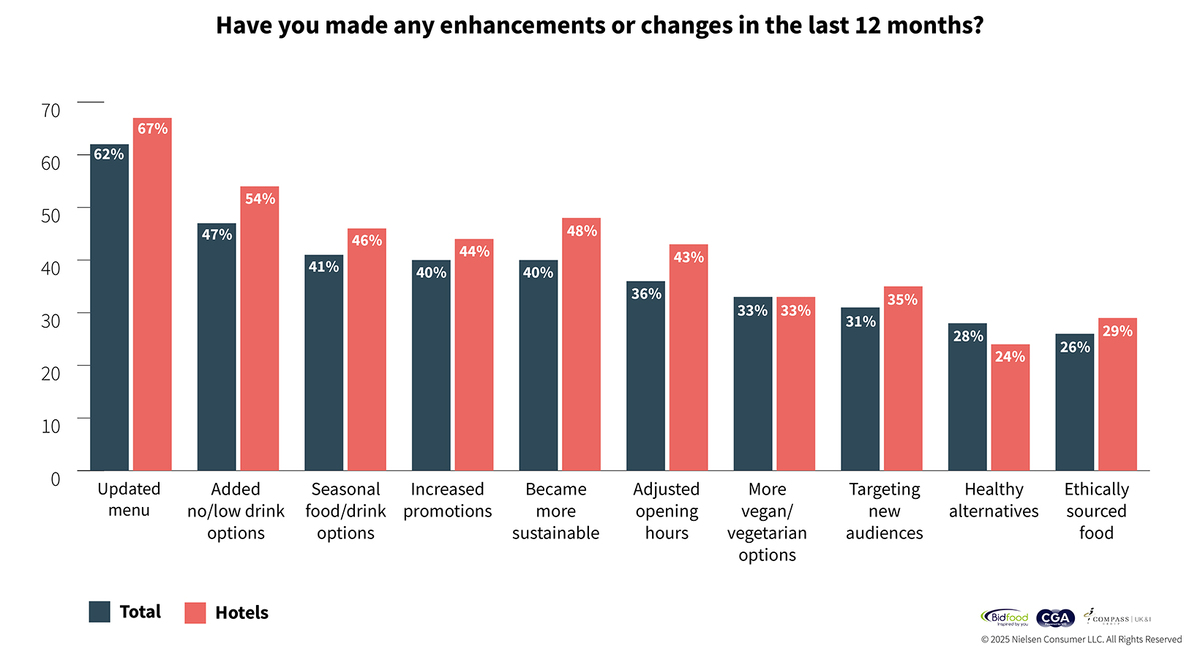
It’s clear that any serious attempt to significantly reduce a business’s carbon impact is a multi-year project. However, 60% of respondents to The Caterer’s Business Leaders Survey said they had not made changes to become more sustainable in the previous 12 months, a proportion that reduced to 52% when hotels were isolated. Of those who have made changes, 26% looked to source food more ethically, rising to 29% among hotel operators.
With the industry having a stated aim of achieving net zero by 2050, UKHospitality chair Kate Nicholls stressed the importance of continuing to take action. She says: “There is no doubt that the challenging cost environment we find ourselves in is making investment in any area, including this one, difficult. If the sector is to be able help the government deliver on its commitment to reach net zero by 2050, it is vital that we see action in the next budget to alleviate some of the tax burden we shoulder. In particular, we are calling for the chancellor to lower business rates, fix National Insurance Contributions and cut VAT, all of which can help unlock funds for investment in areas such as this.”
Businesses leading the field in their sustainable enterprises have already reported wider benefits, including protection against market fluctuations and guest engagement. Patterson says green measures are helping the Savoy to be “in control of our own destiny”, while also meeting increasing interest from guests.
Further legislation is expected in this area, although it is unclear what form this will take. While the industry awaits further information Williams suggests operators make strides now. She says: “I am a strong proponent of operators pushing on at pace to reduce their emissions, as corporate and leisure guests are seeking evidence of your drive to prevent further negative environmental impacts and indeed looking for positive and regenerative measures.”
Ultimately, there seems to be agreement that while it remains a challenging area, cutting emissions is something the industry cannot ignore.

More insight from the Business Leaders surveys
Read the 2025 Business Leaders survey in full
Comparing value with cost: Business leaders offer a path to profit
Business leaders urged to jump in and get involved with AI
How hospitality’s business leaders are tackling recruitment in 2024
Why business leaders are putting sustainability at the top of the agenda
Business Leaders Survey: Is it time for hospitality to bounce back?
Produced in association with
Main photo: PeopleImages/Shutterstock




More from The Caterer
Most Popular


The Acorn Awards 2026
 Sun Jun 7, 2026
The Cateys 2026
Tue Jul 7, 2026
Natural & Organic Food Show
Wed Sep 16, 2026 ExCel London
Artisan Food & Drink Show
Wed Sep 16, 2026ExCel London


The Caterer provides trusted hospitality news, analysis and trends for restaurants, hotels and catering professionals.

Jacobs Media is a company registered in England and Wales, company number 08713328. 3rd Floor, 52 Grosvenor Gardens, London SW1W 0AU.
© 2026 Jacobs Media
